Modulators¶
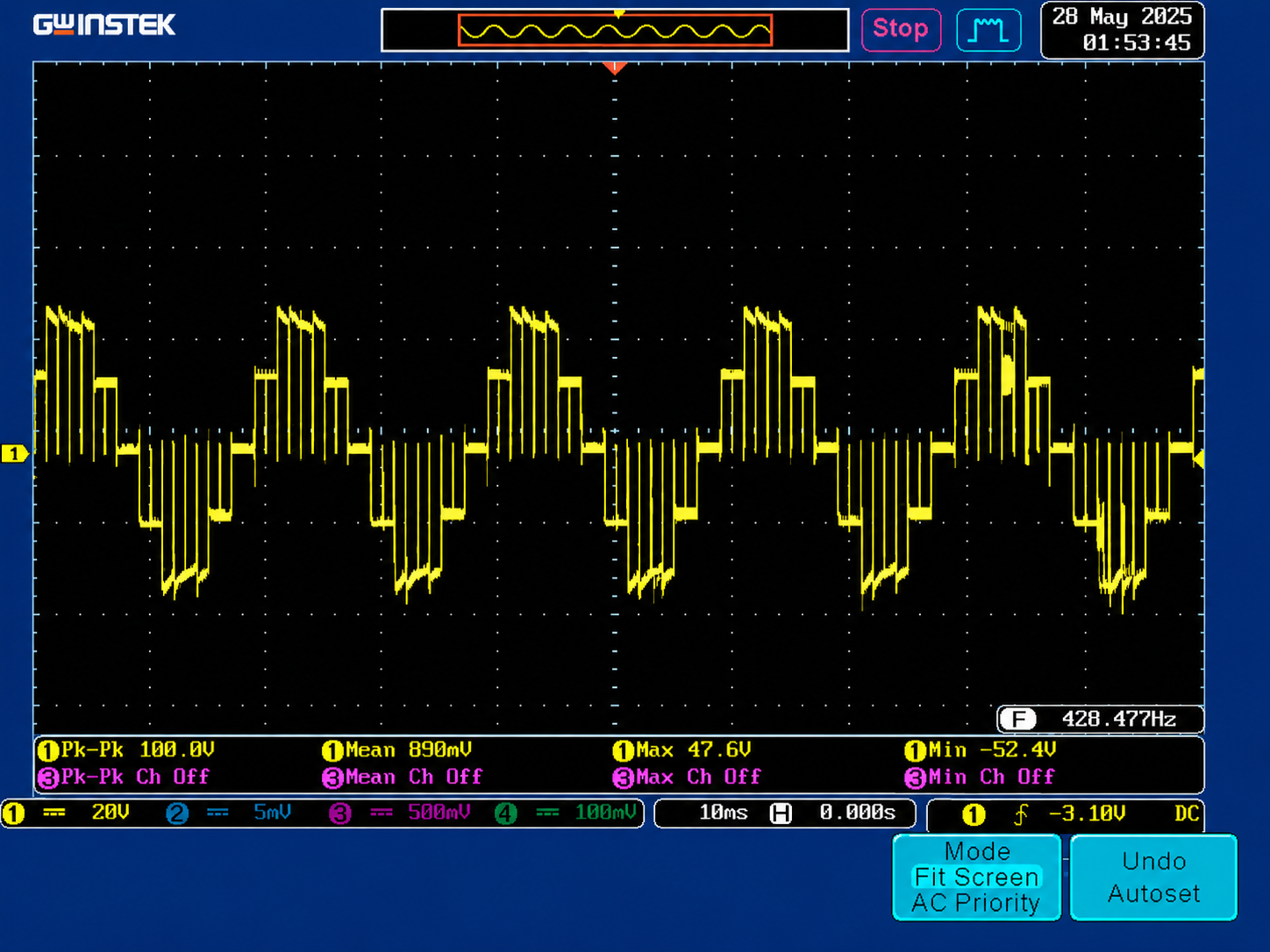
Three modulators ship in the firmware. The active one is selected at runtime over UART (MOD STAIR|PSC|STAIR_ALT) without reflashing.
Comparison¶
| Modulator | What it is | When to use it |
|---|---|---|
STAIR (default boot) |
500 Hz quantize-to-5-levels staircase. Bridge 1 always carries the ±1 step. Not real PWM — each level is held statically with only ≈ 1 % bootstrap-refresh switching. | Known-good fallback, immediately produces 5 distinct levels on the scope. Has a built-in bridge-1 thermal imbalance — use only for short demos. |
PSC |
Unipolar phase-shifted carrier SPWM at the configured switching frequency (default 5 kHz). TIM8 CNT preset to PWM_PERIOD/2 at config time gives the 90° carrier shift between the two cells. Bridge 1 and bridge 2 carry equal switching load. |
The project deliverable. Use for any sustained run. The carrier shift gives natural 5-level output and thermal balance. |
STAIR_ALT |
Same staircase output as STAIR — but the bridge that carries the ±1 step alternates each time the level is re-entered. | Hard-fallback if PSC's 90° shift cannot be made to work on the bench. Fixes the thermal imbalance without changing the visible output shape. Still not real PWM. |
Why PSC over the build guide's IPD LS-PWM¶
Build Guide v3.1 §1.2 specified IPD LS-PWM. The firmware deviates: it runs PSC instead. The reason — captured in the firmware CHANGELOG entry for pwm-rewrite-configurable:
IPD has an inherent bridge-loss asymmetry that needs an additional bridge-swap each fundamental cycle to even out. PSC is naturally bridge-balanced.
This deviation was accepted by the team and is reflected in Build Guide v4.0 §9.
PSC phase-lock diagnostic¶
PSC depends on the TIM8 ↔ TIM1 counter offset being exactly ARR/2. If the offset drifts (e.g. because something clobbers TIM8->CNT after CR1_CEN is set), PSC degrades to 3-level output and the cascade-output spec fails.
To make the failure visible without a scope, the firmware reads back the actual counter offset after every Pwm_SetConfig call and exposes two diagnostics on the $C line:
cntoff=<ticks>— the measured TIM8 - TIM1 counter delta.lock=OK|BAD—OKifcntoffis within±5ticks ofARR/2,BADotherwise.
An operator who sees lock=BAD on the dashboard knows immediately that PSC won't produce 5-level output, and can switch to STAIR_ALT as a hard fallback while debugging.
The hardening fix (writing TIM8->CNT after CR1_CEN is set so the post-UG sequence cannot clobber it) is in Core/Src/pwm_modulator.c::timer_apply_period_and_phase.
Bridge isolation (BRIDGE B1 / BRIDGE B2)¶
For per-bridge bring-up tests, BRIDGE B1 forces bridge 2 into freewheel (both legs at LOW clamp duty, contribution ≈ 0 V) and vice versa. The active bridge produces its normal 3-level (−Vdc / 0 / +Vdc) swing.
Freewheel rather than high-Z is used deliberately: disabling the timer outputs entirely (CCxE=0) would let the output float and the body diodes potentially conduct, which is worse than a controlled freewheel.
Duty clamps¶
| Modulator | LOW clamp | HIGH clamp |
|---|---|---|
| STAIR | 0.01 | 0.95 |
| STAIR_ALT | 0.01 | 0.95 |
| PSC | 0.05 | 0.95 |
The 95 % high clamp ensures the low-side gets ≥ 5 % on-time per period to refresh the bootstrap cap. PSC's higher 5 % low clamp is because PSC actively modulates both legs symmetrically — both clamps bind on both legs. STAIR's "off" leg sits at ~1 % duty (HS almost off, LS almost on); bootstrap is fine on that leg and the 5 % rule only constrains the "on" leg's HS.
Defaults¶
The boot defaults live in Core/Inc/pwm_config.h:
| Value | |
|---|---|
| Modulator | STAIR (the known-good fallback) |
| Switching frequency | 500 Hz |
| Fundamental | 50 Hz |
| Modulation index | 0.95 |
| Bridge select | BOTH |
| Sine LUT size | 256 samples |
| Dead-time | 3 µs (PWM_DEAD_TIME_DTG = TIM_DTG_3US_AT_64MHZ, BDTR.DTG = 0xA0) — sized for the IRFB4110's ~150 nC gate charge |
| Bootstrap precharge | 6 ms (3 PWM periods at 500 Hz) |
After the team's PSC bench validation, flip PWM_DEFAULT_MODULATOR to MODULATOR_PSC so a fresh boot runs the as-built configuration without a manual MOD PSC.